Home · Catalogue · Autographs & Manuscripts · S.I.7108
The Life of St. Columba, Founder of Hy; written by Adamnan, Ninth Abbot of That Monastery. The Text printed from a Manuscript of The Eigth Century; with the Various Readings of Six Other Manuscripts Preserved in Different Parts of Europe. To Which are Added, Copious Notes and Dissertations, Illustrative of The Early History of The Columbian Institutions in Ireland and Scotland.
Adamnan and Reeves, William · Dublin
- Author
- Adamnan and Reeves, William
- Date
- 1857
- Place
- Dublin
- Publisher
- University Press for The Irish Archaeological and Celtic Society
- Language
- English
- Binding
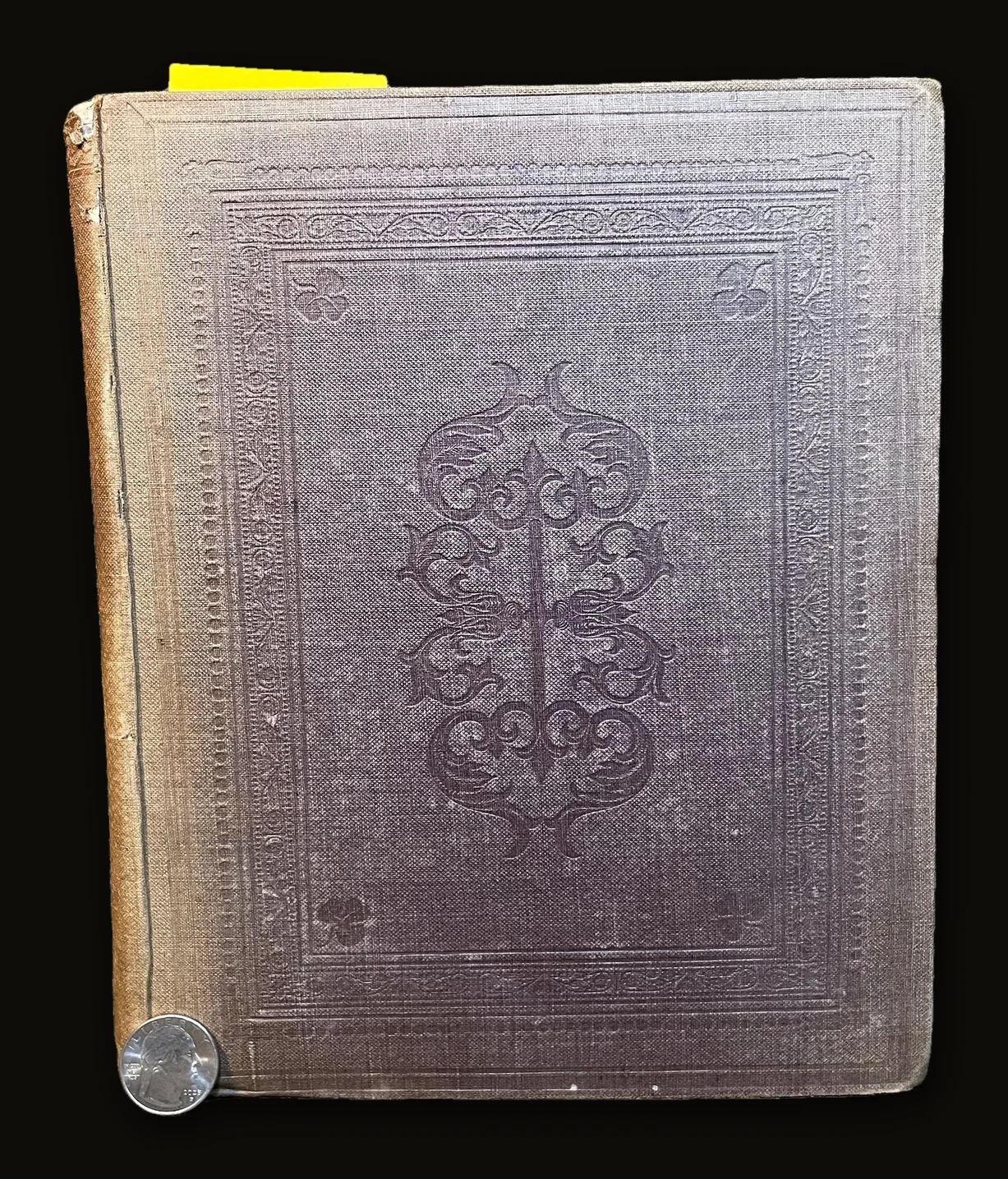
- Tall 8vo.(7.5" x 9.25") Full brown publishers cloth with several blindstamp decorative rule framing an arabesque device centered to each board. Spine with gilt fancy lettered title running horizontially across spine, celtic knot blindstamp rule to head and foot of spine. Yellowed endpapers. Spine sun-faded to a light tan, soiled, head and foot of spine ruffled with small closed tears, head chipped with loss and fraying. Edgewear, corners bumped and rubbed, with tiny loss to tips of lower corners. Dampstains evident on plates, text very good. Color plates in preface, 9 plates total includes map frontispiece of Hibernia.
- Format
- The reverse of the title page has printed "This Copy was Printed for Thomas Cather, Member of the Society. Rear of the volume has a tipped in 10 pg pamphlet of The Irish Archaeologicl and Celtic Society
- Category
- Autographs & Manuscripts
- Record
- S.I.7108
The Life of St. Columba, Founder of Hy; written by Adamnan, Ninth Abbot of That Monastery. The Text printed from a Manuscript of The Eigth Century; with the Various Readings of Six Other Manuscripts Preserved in Different Parts of Europe. To Which are Added, Copious Notes and Dissertations, Illustrative of The Early History of The Columbian Institutions in Ireland and Scotland.
Author: Adamnan and Reeves, William
Tall 8vo.(7.5" x 9.25")1857. Adamnan and Reeves, William. Dublin. University Press for The Irish Archaeological and Celtic Society. Full brown publishers cloth with several blindstamp decorative rule framing an arabesque device centered to each board. Spine with gilt fancy lettered title running horizontially across spine, celtic knot blindstamp rule to head and foot of spine. Yellowed endpapers. Spine sun-faded to a light tan, soiled, head and foot of spine ruffled with small closed tears, head chipped with loss and fraying. Edgewear, corners bumped and rubbed, with tiny loss to tips of lower corners. Dampstains evident on plates, text very good. Color plates in preface, 9 plates total includes map frontispiece of Hibernia.
From Wiki: Columba or Colmcille[a] (7 December 521 – 9 June 597 AD) was an Irish abbot and missionary evangelist credited with spreading Christianity in what is today Scotland at the start of the Hiberno-Scottish mission. He founded the important abbey on Iona, which became a dominant religious and political institution in the region for centuries. He is the patron saint of Derry. He was highly regarded by both the Gaels of Dál Riata and the Picts, and is remembered today as a Catholic saint and one of the Twelve Apostles of Ireland. Columba studied under some of Ireland's most prominent church figures and founded several monasteries in the country. Around 563 AD he and his twelve companions crossed to Dunaverty near Southend, Argyll, in Kintyre before settling in Iona in Scotland, then part of the Ulster kingdom of Dál Riata, where they founded a new abbey as a base for spreading Celtic Christianity among the pagan Northern Pictish kingdoms. He remained active in Irish politics, though he spent most of the remainder of his life in Scotland. Three surviving early medieval Latin hymns are attributed to him.
Adomnán or Adamnán of Iona (c. 624 – 704), also known as Eunan was an abbot of Iona Abbey (r. 679–704), hagiographer, statesman, canon jurist, and saint. He was the author of the Life of Columba, probably written between 697 and 700. This biography is by far the most important surviving work written in early-medieval Scotland and is a vital source for our knowledge of the Picts, and an insight into the life of Iona and the early-medieval Gaelic monk. Adomnán promulgated the Law of Adomnán or "Law of Innocents" (Latin: Lex Innocentium). He also wrote the treatise De Locis Sanctis ('On Holy Places'), an account of the great Christian holy places and centres of pilgrimage. Adomnán got much of his information from a Frankish bishop called Arculf, who had personally visited Egypt, Rome, Constantinople and the Holy Land, and visited Iona afterwards.
William Reeves (16 March 1815 – 12 January 1892) was an Irish antiquarian and the Church of Ireland Bishop of Down, Connor and Dromore from 1886 until his death. He was the last private keeper of the Book of Armagh and at the time of his death was President of the Royal Irish Academy. Reeves resided in Ballymena from 1841 to 1858, when he was appointed vicar of Lusk following the success of his edition of Adomnán's Life of Saint Columba (1857), for which the Royal Irish Academy had awarded him their Cunningham Medal in 1858. He had worked on this with Dr James Henthorn Todd, who was patron of the living at Lusk. Reeves's edition of Adomnán's Life of Columba has been called "the best and fullest collection of materials on the early Irish Church in one volume". With regard to the Celtic Church, Reeves himself described Adomnán's work as – ...an inestimable literary relic... perhaps, with all its defects, the most valuable monument of that ancient institution which has escaped the ravages of time.
Condition
Good
Guaranteed authentic and as described · 7-day returns · free US shipping — our terms. Subject to prior sale.