Home · Catalogue · History & Americana · S.I.7078
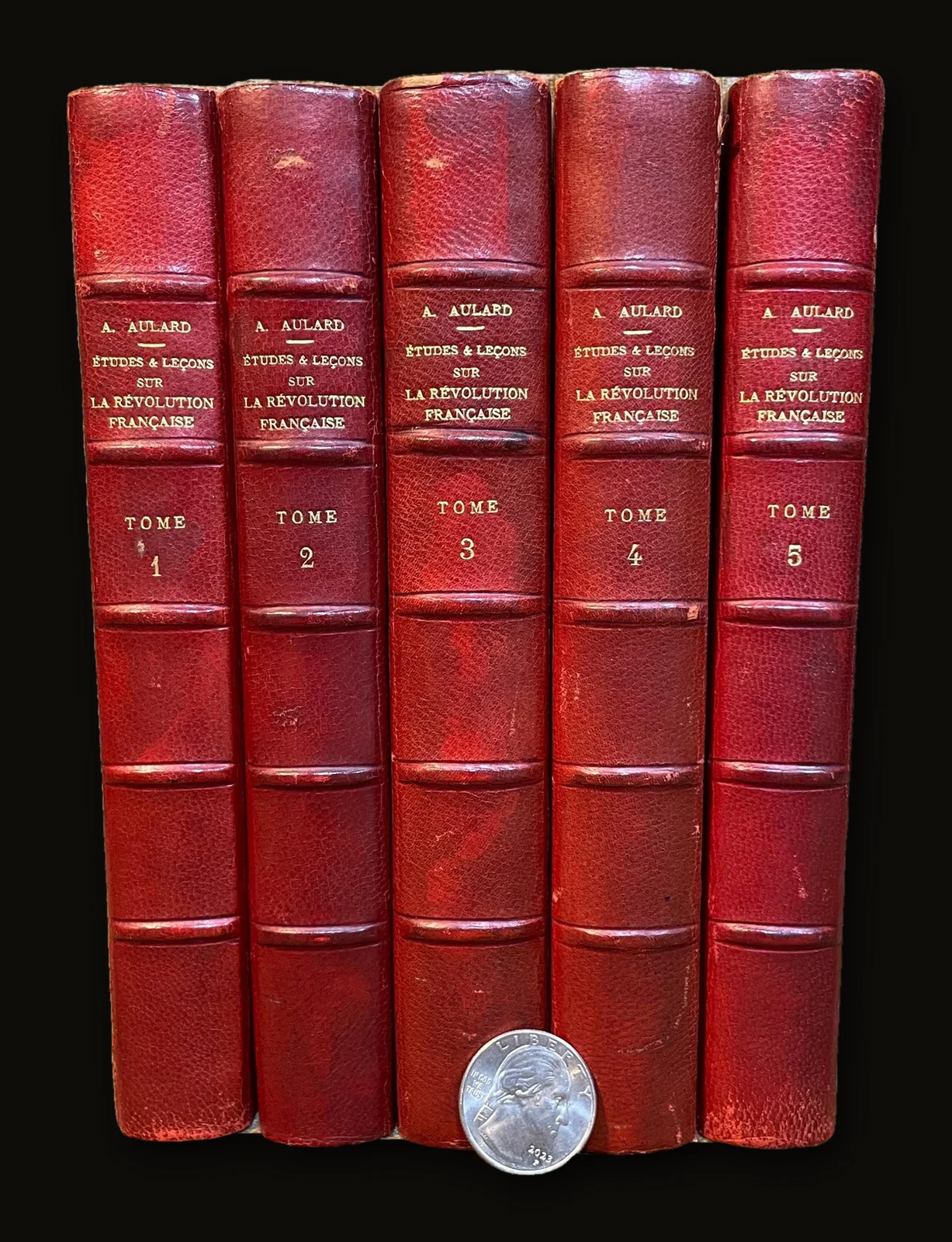
Revolution Francaise
Aulard, Alphonse · Paris
- Author
- Aulard, Alphonse
- Date
- 1909
- Place
- Paris
- Publisher
- Calmann-Levy
- Language
- English
- Binding
- 12mo.(4.5" x 7.125") Quarter red pebbled leather over marbled boards. Spine with five raised bands, gilt author/title to second compartment, top edge gilt, marbled endpapers. Minor edgewear, corners bumped and rubbed, tiny scuffs to extremities, otherwise Near Fine.
- Category
- History & Americana
- Record
- S.I.7078
Revolution Francaise
Author: Aulard, Alphonse (19 July 1849 – 23 October 1928)
12mo.(4.5" x 7.125") 1909. Aulard, Alphonse. Paris. Calmann-Levy.Quarter red pebbled leather over marbled boards. Spine with five raised bands, gilt author/title to second compartment, top edge gilt, marbled endpapers. Minor edgewear, corners bumped and rubbed, tiny scuffs to extremities, otherwise Near Fine.
From Wiki: François Victor Alphonse Aulard (19 July 1849 – 23 October 1928) was the first professional French historian of the French Revolution and of Napoleon. His major achievement was to institutionalise and professionalise the practice of history in France. He entered the École Normale Supérieure in 1867 and obtained the degree of doctor of letters in 1877 with a thesis in Latin on Gaius Asinius Pollio and a French one on Giacomo Leopardi (whose works he subsequently translated into French). Moving from literature to history, he made a study of parliamentary oratory during the French Revolution and published two volumes on Les orateurs de la Constituante (1882) and on Les orateurs de la Legislative et de la Convention (1885). With these works, he established a reputation as a careful scholar well versed in the primary sources of the French Revolution. Appointed professor of the history of the French Revolution at the Sorbonne in 1885, he formed the minds of students who in their turn did valuable work. Nonetheless his views were seen as controversial and "advanced" in a society still under the long influence of the French Revolution. During his course on the Revolution at the Sorbonne in May 1893 violent fist fights broke out. At the exit rival gangs yelled at each other "Down with Aulard" and, in opposition to a Roman Catholic clergy identified with the Ancien Régime, "Down with the skullcap". Applying to the study of the French Revolution the rules of historical criticism which had produced such rich results in the study of ancient and medieval history, Aulard devoted himself to profound research in the archives and to the publication of numerous important contributions to the political, administrative and moral history of that period. His masterwork was a Histoire politique de la Revolution française (4 vol, 3rd ed. 1901). "From the social point of view, the Revolution consisted in the suppression of what was called the feudal system, in the emancipation of the individual, in greater division of landed property, the abolition of the privileges of noble birth, the establishment of equality, the simplification of life. The French Revolution differed from other revolutions in being not merely national, for it aimed at benefiting all humanity." Aulard divided the French Revolution into "four epochs: 1789- 1792, during which democratic and republican parties were formed under a constitutional monarchy; 1792-1795, during which a democratic republic existed; 1795-1799, the period of the bourgeois republic; and 1799-1804, that of the plebiscitary republic." Aulard's historiography was based on positivism. The assumption was that methodology was all-important and the historian's duty was to present in chronological order the duly verified facts to analyze relations between facts and provide the most likely interpretation. Full documentation based on research in the primary sources was essential. He took the lead in the publication very important documents and in training advanced students in the proper use and analysis of primary sources. Aulard's famous four volume history of the Revolution focused on parliamentary debates, not action in the street; and in institutions, not insurrections. He emphasized public opinion, elections, parties, parliamentary majorities and legislation. He recognized the complications that prevented the Revolution from fulfilling all its ideal promises as when the legislators of 1793 made a suffrage universal for all men, but also established the dictatorship of the Reign of Terror.
We are currently putting all 5000+ titles online, but if there is a specific title you are looking for, please reach out to sidekerbookselleratgmail.com, we may just have it!
Free shipping via USPS for United State purchaser within the continental U.S., International shipping determined using USPS Priority Express, DHL, FedEx, or Parcel Monkey.
Sonny Ideker Bookseller is located within City Antiques in Historic Roswell, Georgia at 700 Holcomb Bridge Road, Roswell, GA. 30076. We would love to have you visit or email us at sidekerbookselleratgmail.com for specific wants or needs, thanks!
Find Us On: Facebook: https://www.facebook.com/p/Sonny-Ideker-Bookseller-Rare-Antiquarian-Leather-Vellum-Bound-Books-100068669041560/ YouTube: https://www.youtube.com/@SonnyIdekerBookseller/about Instagram: https://www.instagram.com/sonny_ideker_bookseller Flickr: https://flic.kr/ps/2v6pn4 Website: https://sonnyideker.weebly.com/ Antique Books, Old Leather Book, Old Vellum Book, Decorative Binding, Antiquarian Book, Vintage decorative, Ancient Leather, Rare Books, Decorative Books, Decorative Leather, Beautiful Decorative Book That Rare Book Guy Sonny Ideker City Antiques & Interior Arts Georgia Antiquarian Booksellers Association Colette French Pastries
Condition
Good+
Guaranteed authentic and as described · 7-day returns · free US shipping — our terms. Subject to prior sale.