Home · Catalogue · Fore-Edge Paintings · S.I.7539
The Art of Glen Loates. Limited Editon
Duval, Paul and Loates, Glen (Illust.) · Toronto
- Author
- Duval, Paul and Loates, Glen (Illust.)
- Date
- 1978
- Place
- Toronto
- Publisher
- Cerebus Publishing Company Limited
- Language
- English
- Binding
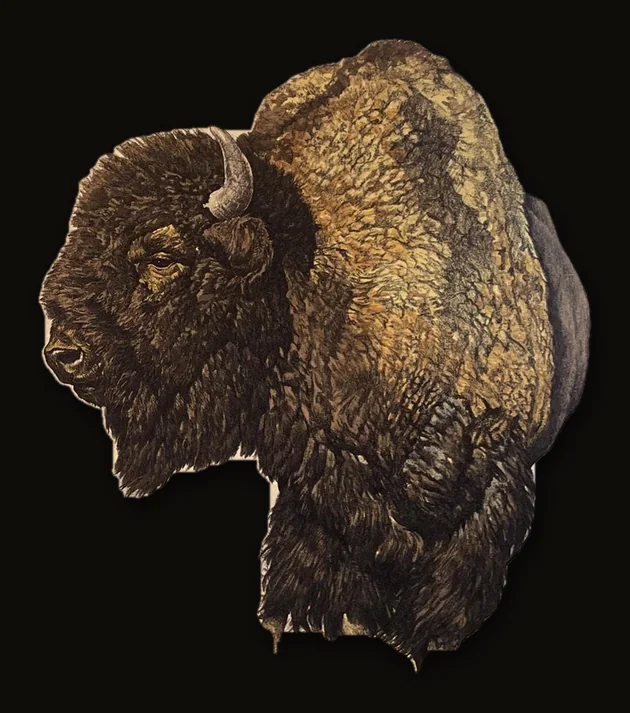
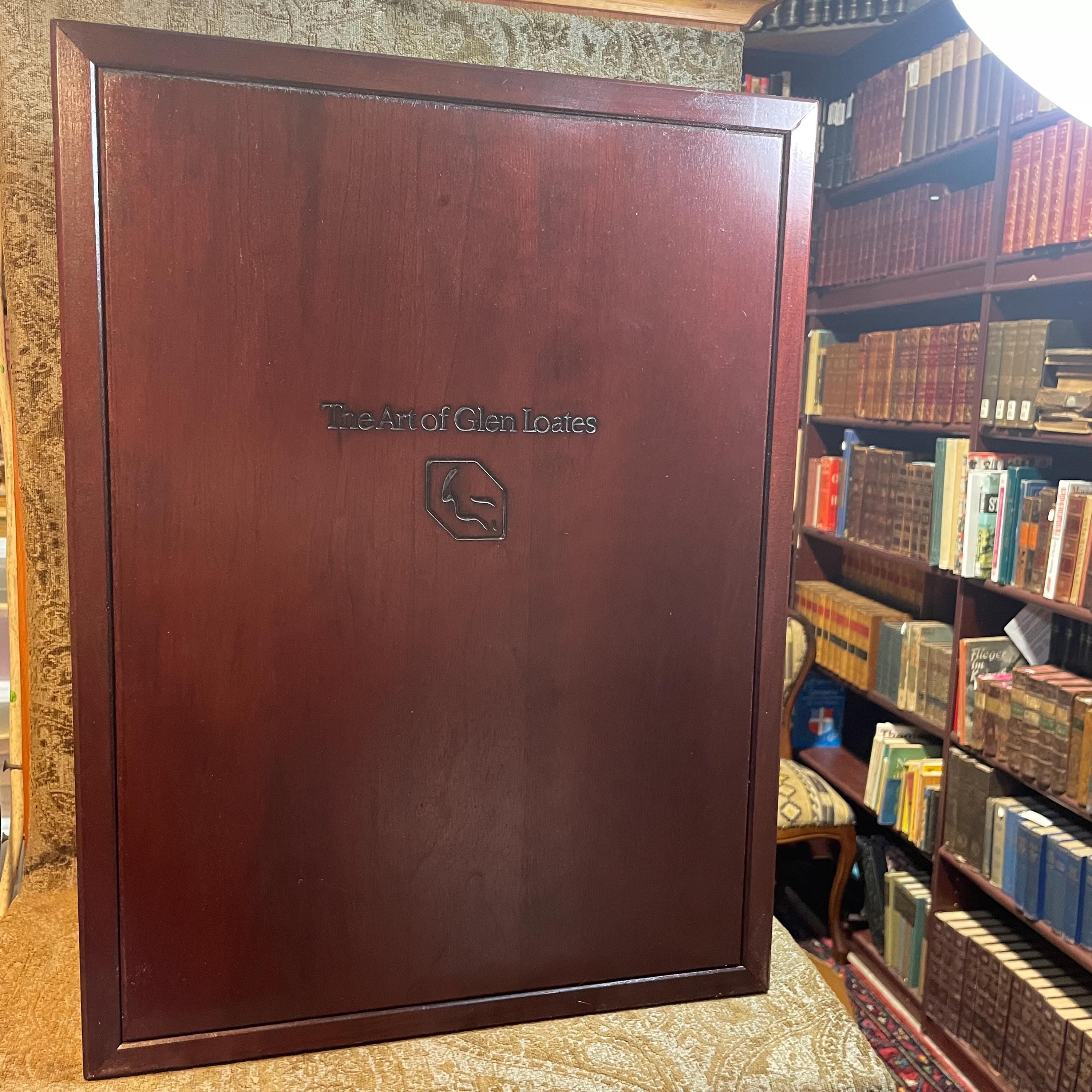
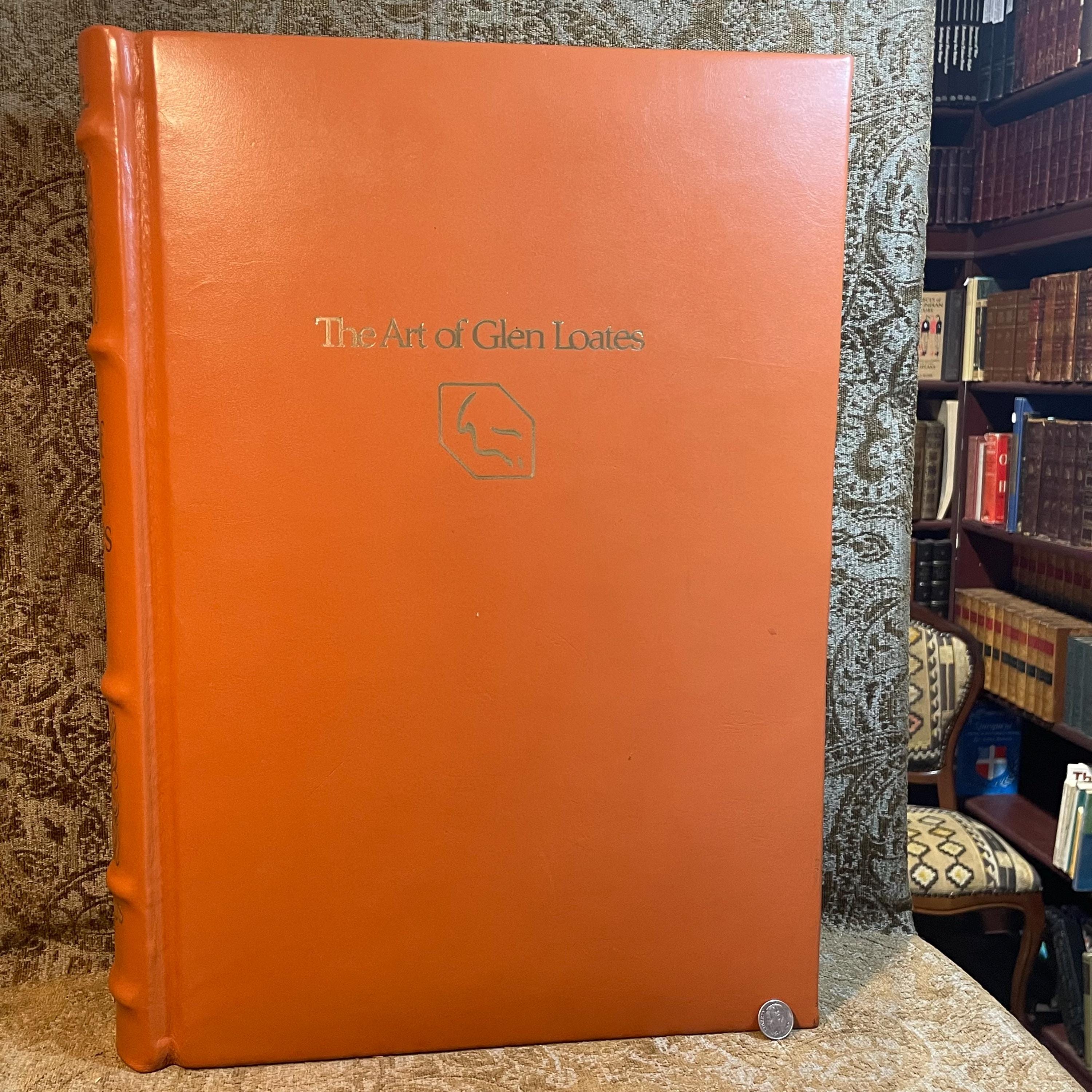
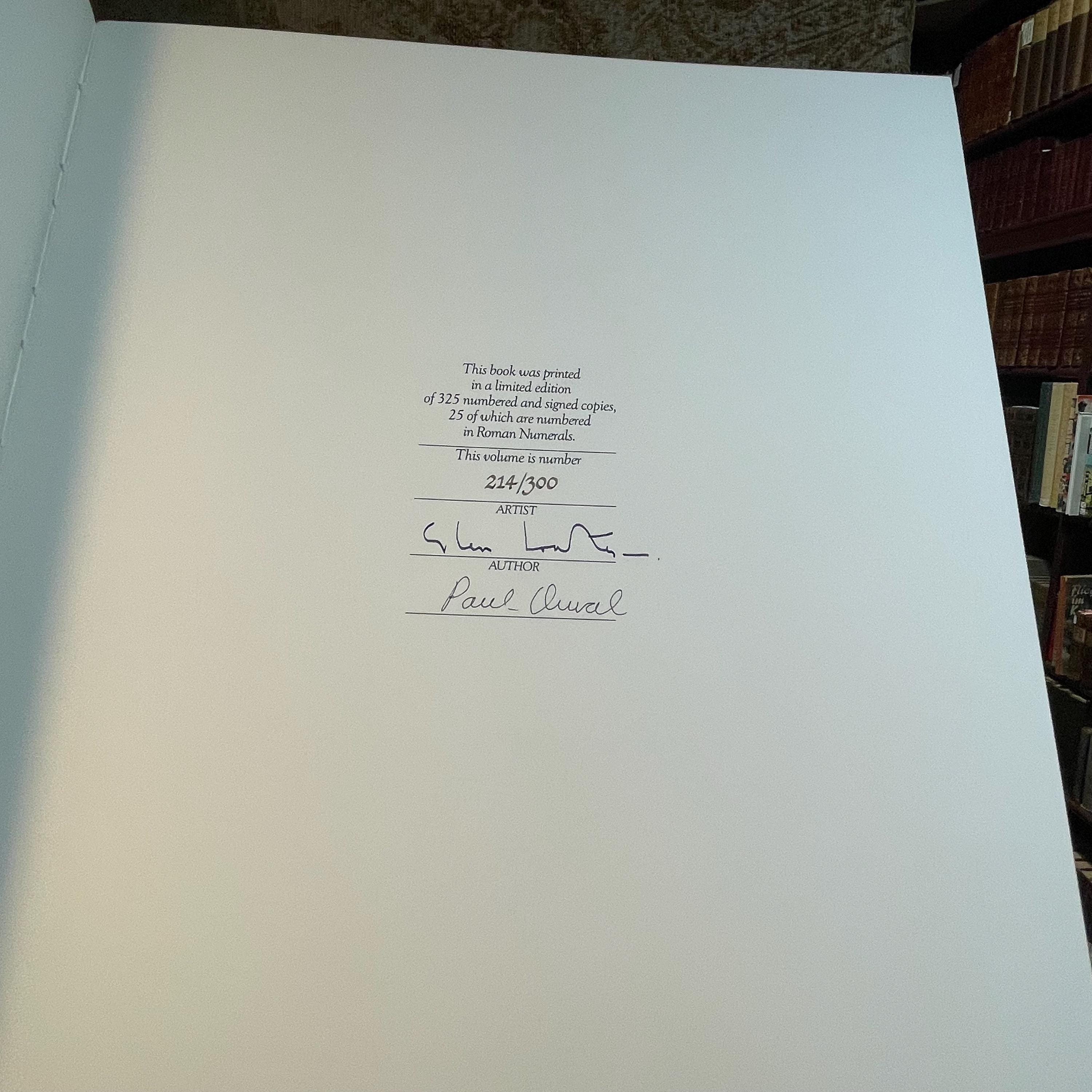
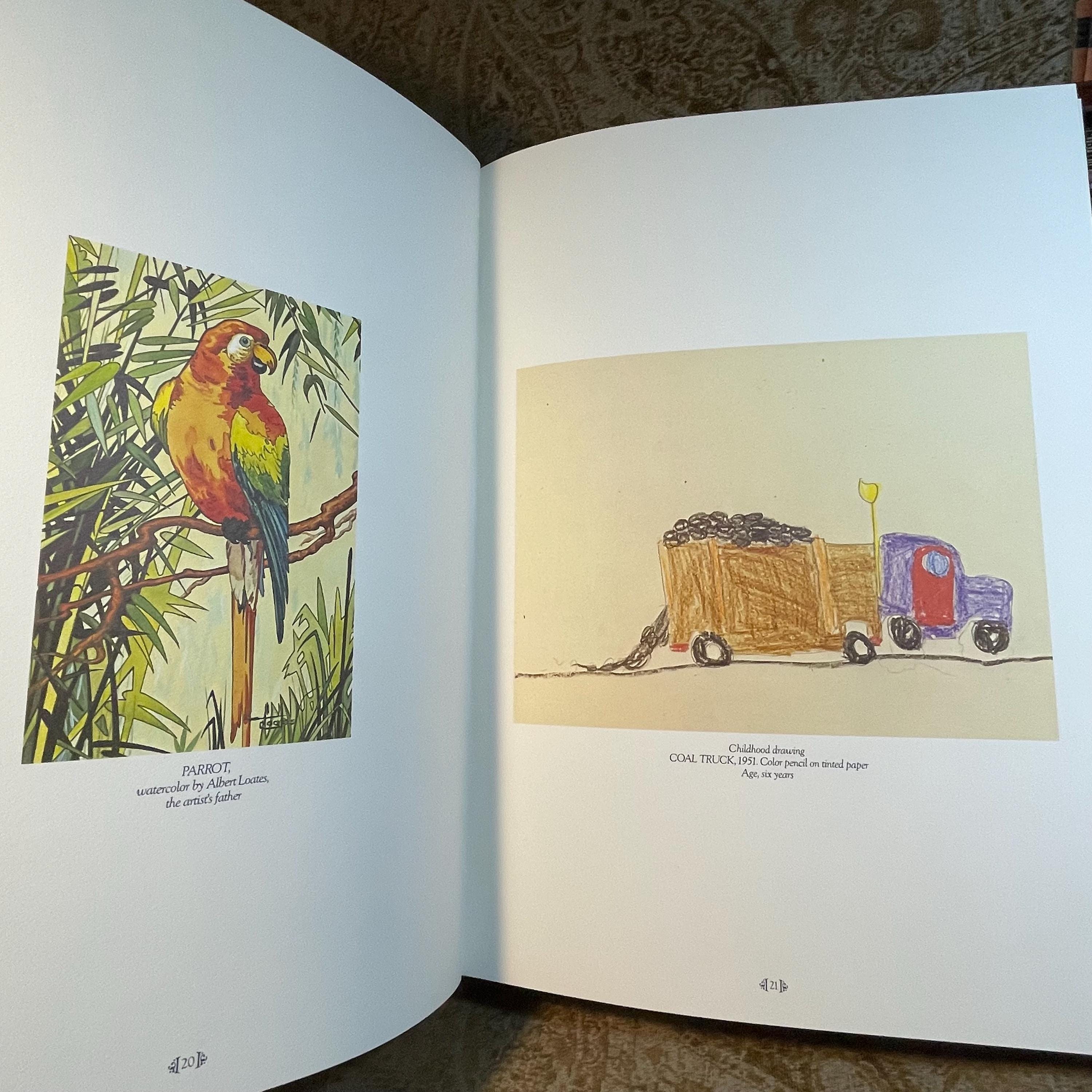
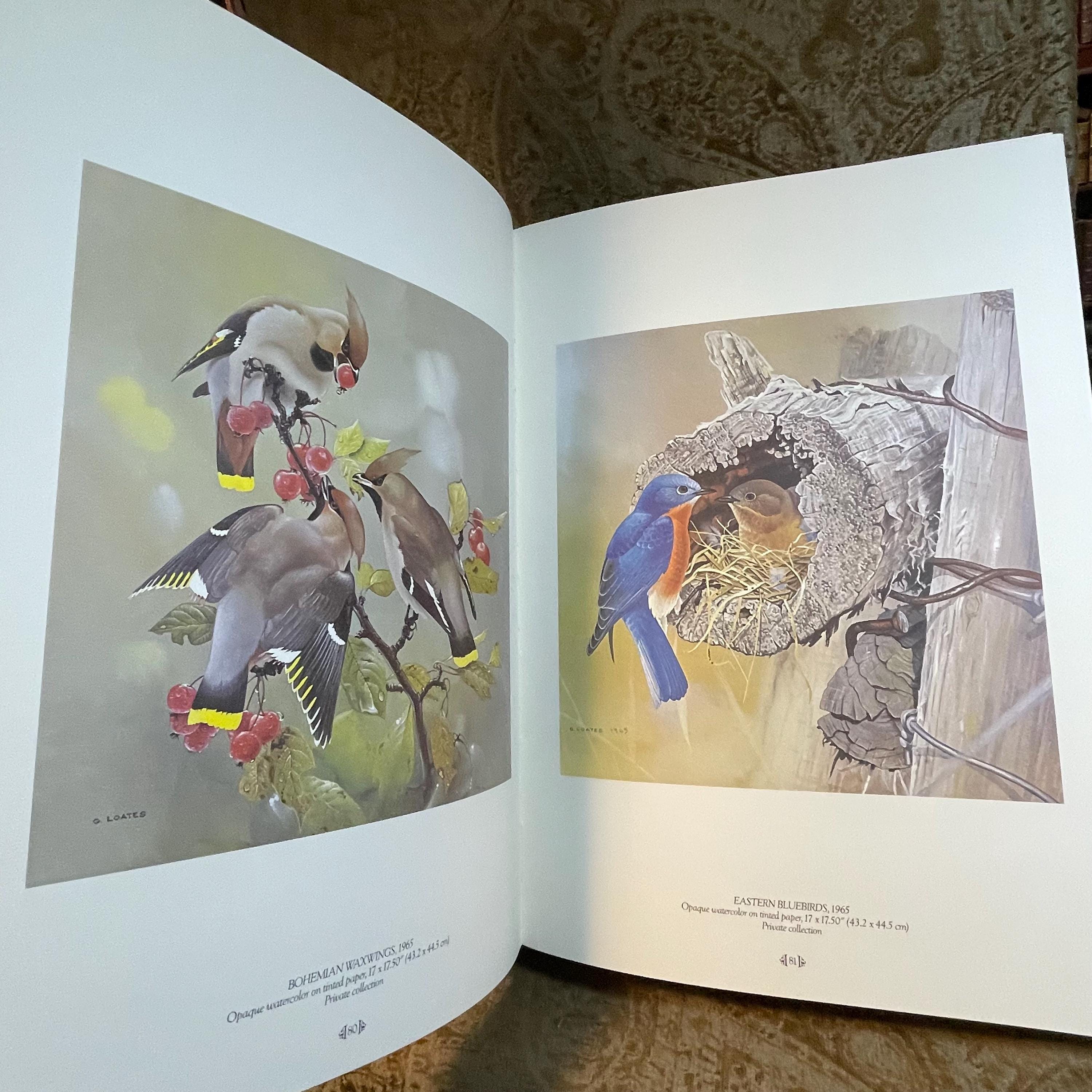
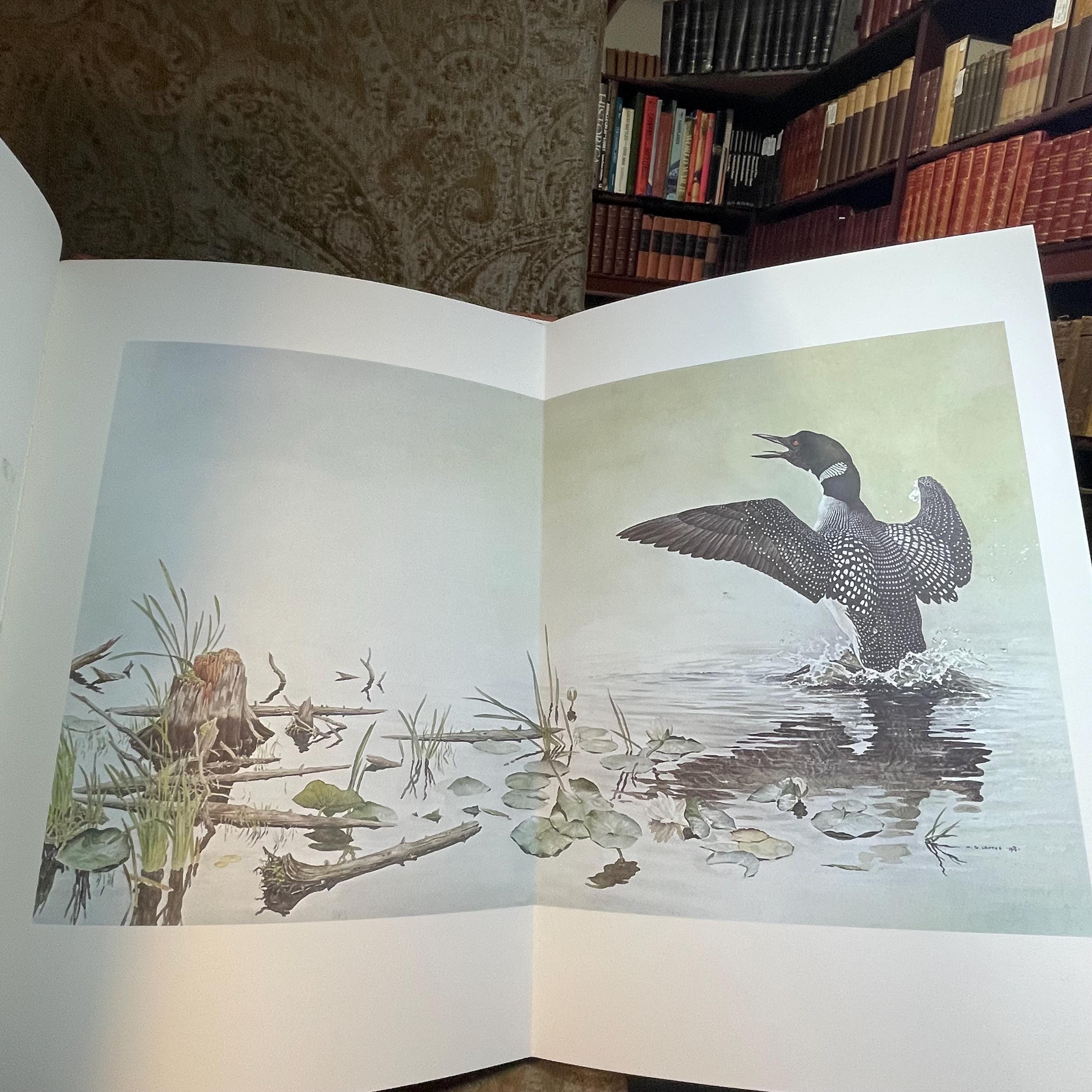
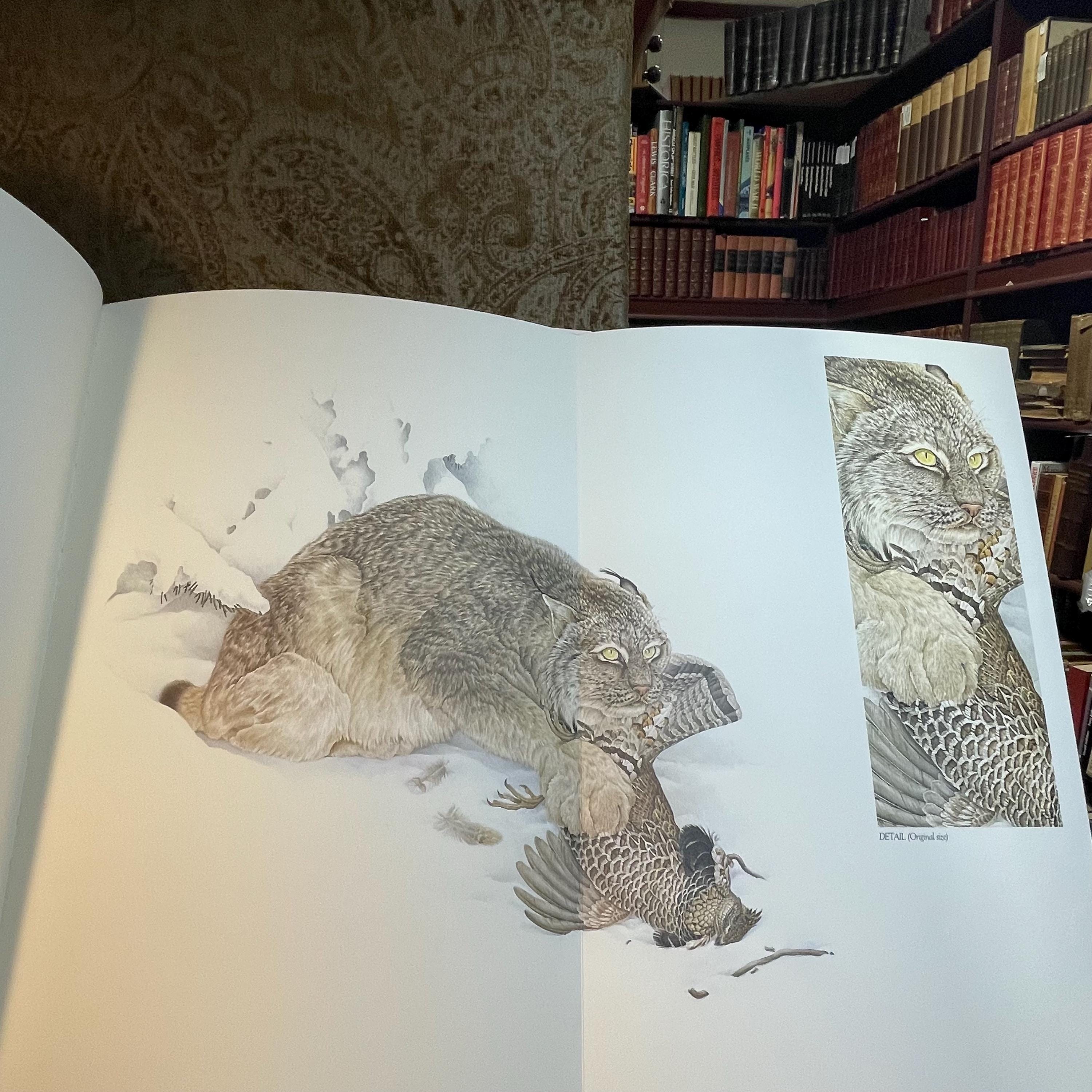
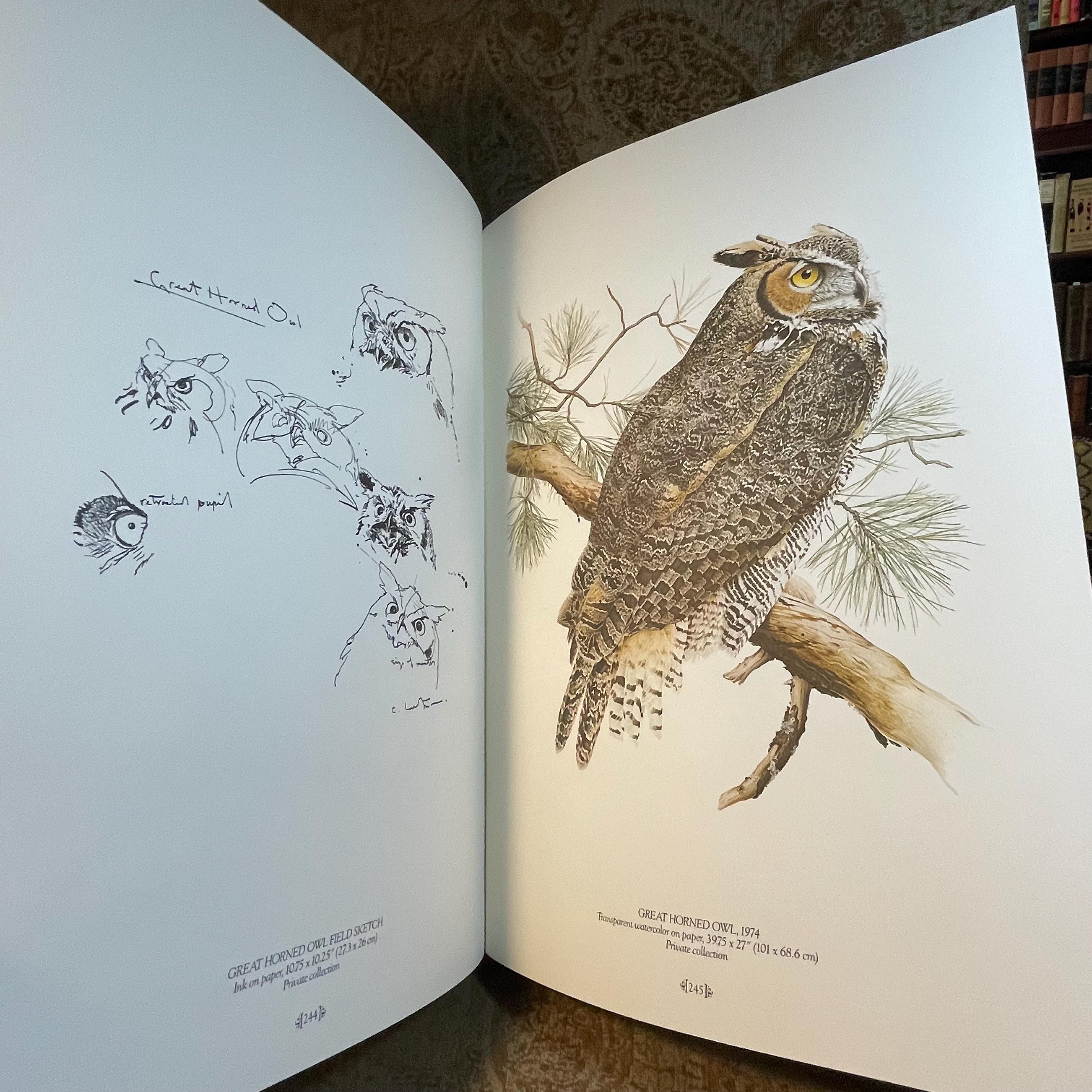
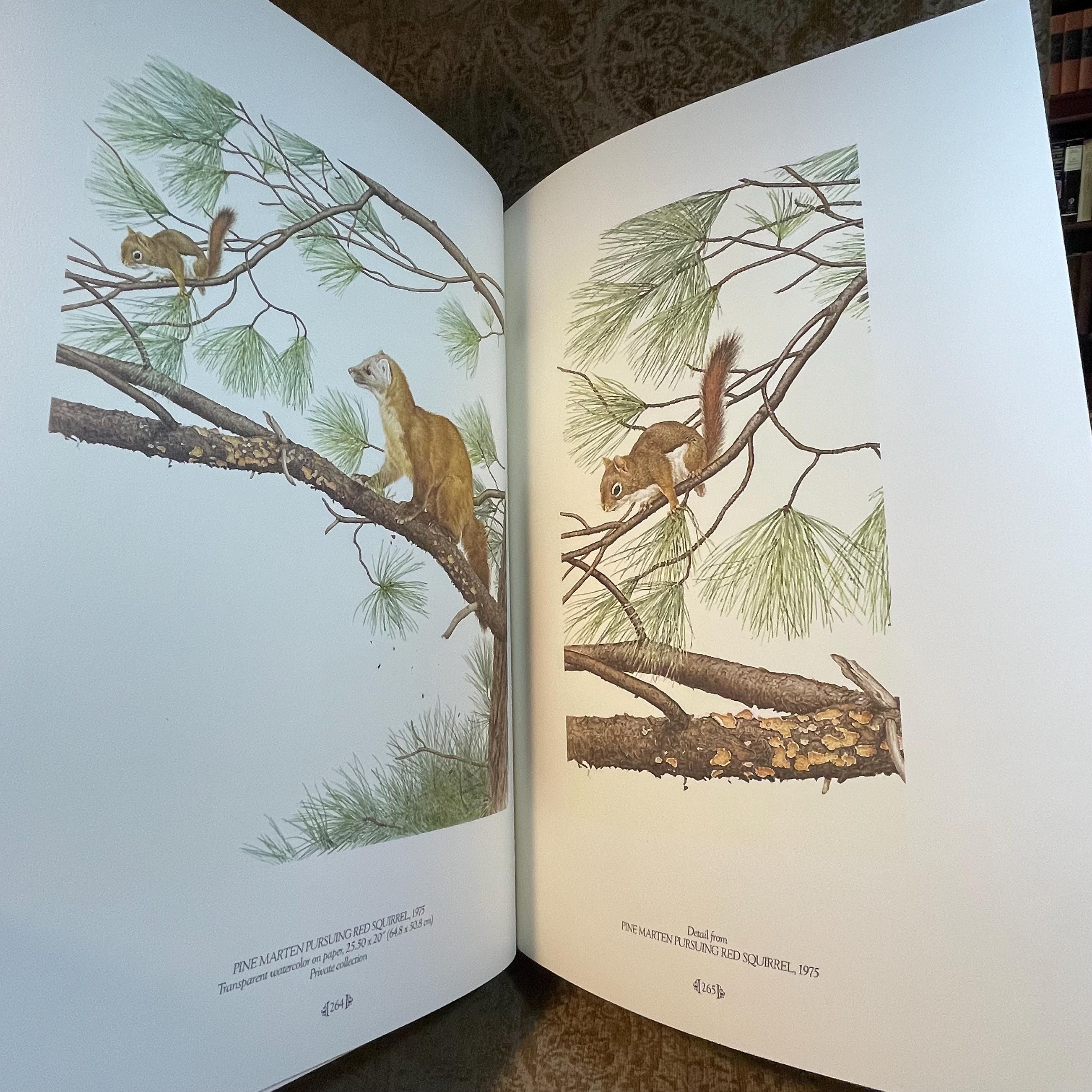
- Folio.(12.25" x 17.5") Limited Edition #214/300 in slipcover with matching portfolio of a Limited Edition print of Buffalo. Full russet calf with gilt title and facsimile of Artist's Signature centered to upper board, rear blank. Spine with five raised bands, gilt author to first compartment, gilt title/artist to third, gilt publisher to fifth compartment, large gilt floral devices to second and fourth compartments. Marbled endpapers, top and bottom edge gilt, fore-edge speckled brown. Tips of corners slightly rubbed, faint scuffs visible on upper board seen in raking light. Attestation page with signatures of author and artist. A 13.25" x 18" folio in beige buckram accompanies the text. The folio has a gilt title and blindstamped facsimile signature centered to the upper board, rear blank, with marbled endpapers. The fine folio contains a russet paper sleeve with gilt title and facsimile signature similar to the folio cover, containing a protective tissue guard and a Limited Edition #214/300 36-color original lithograph (17" x 12.25") titled Bison, 1976. Folio states: "Edition of 325 Numbered and signed by the Artist, No Artist's proofs. Copper Plates Destroyed". Both the book and the folio are contained within a biege buckram slipcase in near fine condition, with a gilt title and blindstamped facsimile signature similar to the folio, with small spots to slipcover fabric otherwise Fine. All of this, the book, the folio, and slipcover snuggly fit into a custom cherry wood box with brass lock and key. The box has the title and facsimile signature engraved into its lid. An incredible presentation for a book with amazing color plates of natural history as depicted in nature by Glen Loates.
- Format
- Attestation page states: "This Book was printed in a Limited Edition of 325 numbered and signed copies, 25 of which are numbered in Roman Numerals. This volume is number 214/300." and signed by the Author and Illustrator. The making of this book: DESIGN & TYPOGRAPHY With the growth of the industrial revolution, craftsmen and guilds became replaced with individuals and machines. By the mid-20th century, the bookshelves of America reflected mass production, perfect binding and uniformity. The book guilds of our fathers no longer held sway as craftsmen who added their sensitive touch to preserve the art of bookmaking. Modern phototypesetting and printing allowed for far greater volume and the resulting economy. It also allows many of the production frustrations of our past bookbinders to disappear. This volume of the book is an attempt at combining the art of hand-lettering of its own heritage. With modern advances in method, good reproduction and design, we honor production and tradition. BODY TYPEFACE The choice of the appropriate text-face for this book must be judged for its merits of design. Although there is always the designer, he must weigh history of the typeface and the medium and means of printing. The typeface selected is Goudy Old Style. The design is the heritage of William Goudy, considered the most prolific of the American type designers, at a time when America was free from dependence on European designers. Goudy was the only letter form artist in America to have his own press studio. He inspired the modern American typeface of a humanist and renaissance typestyle. Although the Goudy family of faces are his design of many others, including: De Vinne Roman 1898, Forum Capitals 1917, Hadriano 1918, Lanston Monotype 1921, Kaatskill 1929 and Kennerley. Frederic William Goudy died in 1947. DISPLAY TYPEFACE The display face was selected for its ability to complement the text-face and for its restrained, simple form. Diethelm roman and bold face were designed in 1948 by Walter Diethelm. BRACKETS The folio brackets used in this book are Monotype 567 & 568. INITIALS Initial letters were originally devised as a means of display decoration for the manuscript marketplace. With the invention of movable type printing, the woodcut initials were made as small text blocks. Full reproductions of the hand inserted initials disappeared after the fifteenth century. They re-emerged in the twentieth century in antique texts, covering the style of Venetian, Florentine, Augsburg, Basle, Cologne and Antwerp. Originally, it was the hand engraved initials of wood, and later the ages, by the artists who brought their art to print, such as Holbein and Dürer. The American artist, Glen Edwards, researched historical initials and rendered an ideal letter should the undertaking be necessary. The decoration utilized in this volume is of a woodcut style of drawing, based upon the designs of William Morris, one of the greatest designers of the arts and crafts movement. PAPER The paper was manufactured specifically for this volume by Domtar Fine Paper Ltd., in its high quality paper mill located at Beauharnois, Quebec. The specially designed sheet represents the ultimate in the art of paper making. It was manufactured to meet the rigid requirements of this project. The 280M stock of Cerberus Handmade is a 100% rag sheet and of archival stock to age and mature with the valuable effects of aging. PRINTING Special hand-mixed Hostmann-Steinberg high pigmented inks were used in order to retain the clarity and character of the original paintings. The artwork was repeated many times to achieve the highest quality facsimile and detail possible. A skilled craftsman employed a 72 x 102 cm single color Heidelberg Offset press while the artist initialed his approval and complete satisfaction as each color was laid down during the entire process. Upon completion, all working and supportive materials were destroyed. Documentation of the destruction of these materials is on record. BOOKBINDING Today’s artisan methods make the hand binding techniques used in this volume economical. A description of the many steps required to produce a book of this nature takes the presentation to a special means of hand preservation in itself. After the sewing is gathered, each signature is collated in 16 sections. The sections are then hand folded, glued, sewn and aligned, sewn and re-sewn to ensure the highest durability. The endleaves (sixteen were required to separate the boards) are adhered, cross glued and trimmed, hand scored with side boards to tie up off the waste paper and square up the volume. Upon completion, the gold leaf edge is applied and the leading edge is brown flaked. The volumes are stored on the frames to remove any trapped heat between them. Rope is placed into the five hub wells on the spine, and stored in leather, to stretch around the padded plate boards required in a Knight press for 48 hours until dry. Each volume required a total of sixteen days to bind. LITHOGRAPH The original thirty-six color lithograph was reproduced on American Etching, a 100% rag content sheet. Using oil based inks, hand mixed at the press, the artist applied a sequence of colors based on the application of solid background shades upon which were added minute details in a myriad of colors to highlight the grandeur and beauty of the Bison. All the copper plates and trial provings used in production were destroyed in the presence of both the artist and the author, to safeguard the limited nature of the edition.
- Category
- Fore-Edge Paintings
- Record
- S.I.7539
The Art of Glen Loates. Limited Editon
Author: Duval, Paul and Loates, Glen (Illust.) (born 1945)
Folio.(12.25" x 17.5")1978.Duval, Paul and Loates, Glen (Illust.) Toronto. Cerebus Publishing Company Limited. Limited Edition #214/300 in slipcover with matching portfolio of a Limited Edition print of Buffalo. Full russet calf with gilt title and facsimile of Artist's Signature centered to upper board, rear blank. Spine with five raised bands, gilt author to first compartment, gilt title/artist to third, gilt publisher to fifth compartment, large gilt floral devices to second and fourth compartments. Marbled endpapers, top and bottom edge gilt, fore-edge speckled brown. Tips of corners slightly rubbed, faint scuffs visible on upper board seen in raking light. Attestation page with signatures of author and artist. A 13.25" x 18" folio in beige buckram accompanies the text. The folio has a gilt title and blindstamped facsimile signature centered to the upper board, rear blank, with marbled endpapers. The fine folio contains a russet paper sleeve with gilt title and facsimile signature similar to the folio cover, containing a protective tissue guard and a Limited Edition #214/300 36-color original lithograph (17" x 12.25") titled Bison, 1976. Folio states: "Edition of 325 Numbered and signed by the Artist, No Artist's proofs. Copper Plates Destroyed". Both the book and the folio are contained within a biege buckram slipcase in near fine condition, with a gilt title and blindstamped facsimile signature similar to the folio, with small spots to slipcover fabric otherwise Fine. All of this, the book, the folio, and slipcover snuggly fit into a custom cherry wood box with brass lock and key. The box has the title and facsimile signature engraved into its lid. An incredible presentation for a book with amazing color plates of natural history as depicted in nature by Glen Loates. "Attestation page states: ""This Book was printed in a Limited Edition of 325 numbered and signed copies, 25 of which are numbered in Roman Numerals. This volume is number 214/300."" and signed by the Author and Illustrator. The making of this book: DESIGN & TYPOGRAPHY With the growth of the industrial revolution, craftsmen and guilds became replaced with individuals and machines. By the mid-20th century, the bookshelves of America reflected mass production, perfect binding and uniformity. The book guilds of our fathers no longer held sway as craftsmen who added their sensitive touch to preserve the art of bookmaking. Modern phototypesetting and printing allowed for far greater volume and the resulting economy. It also allows many of the production frustrations of our past bookbinders to disappear. This volume of the book is an attempt at combining the art of hand-lettering of its own heritage. With modern advances in method, good reproduction and design, we honor production and tradition. BODY TYPEFACE The choice of the appropriate text-face for this book must be judged for its merits of design. Although there is always the designer, he must weigh history of the typeface and the medium and means of printing. The typeface selected is Goudy Old Style. The design is the heritage of William Goudy, considered the most prolific of the American type designers, at a time when America was free from dependence on European designers. Goudy was the only letter form artist in America to have his own press studio. He inspired the modern American typeface of a humanist and renaissance typestyle. Although the Goudy family of faces are his design of many others, including: De Vinne Roman 1898, Forum Capitals 1917, Hadriano 1918, Lanston Monotype 1921, Kaatskill 1929 and Kennerley. Frederic William Goudy died in 1947. DISPLAY TYPEFACE The display face was selected for its ability to complement the text-face and for its restrained, simple form. Diethelm roman and bold face were designed in 1948 by Walter Diethelm. BRACKETS The folio brackets used in this book are Monotype 567 & 568. INITIALS Initial letters were originally devised as a means of display decoration for the manuscript marketplace. With the invention of movable type printing, the woodcut initials were made as small text blocks. Full reproductions of the hand inserted initials disappeared after the fifteenth century. They re-emerged in the twentieth century in antique texts, covering the style of Venetian, Florentine, Augsburg, Basle, Cologne and Antwerp. Originally, it was the hand engraved initials of wood, and later the ages, by the artists who brought their art to print, such as Holbein and Dürer. The American artist, Glen Edwards, researched historical initials and rendered an ideal letter should the undertaking be necessary. The decoration utilized in this volume is of a woodcut style of drawing, based upon the designs of William Morris, one of the greatest designers of the arts and crafts movement. PAPER The paper was manufactured specifically for this volume by Domtar Fine Paper Ltd., in its high quality paper mill located at Beauharnois, Quebec. The specially designed sheet represents the ultimate in the art of paper making. It was manufactured to meet the rigid requirements of this project. The 280M stock of Cerberus Handmade is a 100% rag sheet and of archival stock to age and mature with the valuable effects of aging. PRINTING Special hand-mixed Hostmann-Steinberg high pigmented inks were used in order to retain the clarity and character of the original paintings. The artwork was repeated many times to achieve the highest quality facsimile and detail possible. A skilled craftsman employed a 72 x 102 cm single color Heidelberg Offset press while the artist initialed his approval and complete satisfaction as each color was laid down during the entire process. Upon completion, all working and supportive materials were destroyed. Documentation of the destruction of these materials is on record. BOOKBINDING Today’s artisan methods make the hand binding techniques used in this volume economical. A description of the many steps required to produce a book of this nature takes the presentation to a special means of hand preservation in itself. After the sewing is gathered, each signature is collated in 16 sections. The sections are then hand folded, glued, sewn and aligned, sewn and re-sewn to ensure the highest durability. The endleaves (sixteen were required to separate the boards) are adhered, cross glued and trimmed, hand scored with side boards to tie up off the waste paper and square up the volume. Upon completion, the gold leaf edge is applied and the leading edge is brown flaked. The volumes are stored on the frames to remove any trapped heat between them. Rope is placed into the five hub wells on the spine, and stored in leather, to stretch around the padded plate boards required in a Knight press for 48 hours until dry. Each volume required a total of sixteen days to bind. LITHOGRAPH The original thirty-six color lithograph was reproduced on American Etching, a 100% rag content sheet. Using oil based inks, hand mixed at the press, the artist applied a sequence of colors based on the application of solid background shades upon which were added minute details in a myriad of colors to highlight the grandeur and beauty of the Bison. All the copper plates and trial provings used in production were destroyed in the presence of both the artist and the author, to safeguard the limited nature of the edition. " Limited Edition #214/300
From Wiki: Martin Glen Loates (born 1945) is a Canadian artist who paints wildlife and landscapes in a naturalistic style. Loates has designed a number of coins for the Royal Canadian Mint. In 1982, the former Canadian Prime Minister Pierre Elliott Trudeau arranged for Loates to meet with US President Ronald Reagan in the Oval Office to present his painting, The Bald Eagle to the American people on behalf of Canada. Loates' paintings have been gifted to Prince Philip, Duke of Edinburgh, and Pierre Elliot Trudeau. In the 1984 book A Brush With Life, Glen Loates explained his love for his nature saying, "I've taken more from nature than I can ever give in return. I owe so much, having painted all these beautiful things. If I can assist in preserving natural areas by lending my name to conservation projects or by using my art to draw attention to environmental issues, I feel I'm repaying an enormous debt of gratitude." Loates became interested in art at a young age by exploring the woods around the family house in Newtonbrook, Ontario, and was introduced to watercolours by Frederick Henry Brigden, founder of the Canadian Watercolourist Society. Bridgen encouraged Loates to focus on drawing wildlife, but Loates also continued to draw comics for his own enjoyment. At age 11, Loates drew the iconic yellow daffodil that has represented the Canadian Cancer Society for over 40 years. Loates has been the subject of several documentaries, one of which was Color it Living.
We are currently putting all 5000+ titles online, but if there is a specific title you are looking for, please reach out, we may just have it!
Free shipping via USPS for United State purchaser within the continental U.S., International shipping determined using USPS Priority Express, DHL, FedEx, or Parcel Monkey.
Sonny Ideker Bookseller is located within City Antiques in Historic Roswell, Georgia at 700 Holcomb Bridge Road, Roswell, GA. 30076. We would love to have you visit or email us for specific wants or needs, thanks!
Antique Books, Old Leather Book, Old Vellum Book, Decorative Binding, Antiquarian Book, Vintage decorative, Ancient Leather, Rare Books, Decorative Books, Decorative Leather, Beautiful Decorative Book That Rare Book Guy Sonny Ideker City Antiques & Interior Arts Georgia Antiquarian Booksellers Association
Condition
Near Fine
Guaranteed authentic and as described · 7-day returns · free US shipping — our terms. Subject to prior sale.